
Most growth ambitions are reasonable. The constraint is rarely the ambition itself — it is whether the commercial model underneath can execute it consistently. Roles, routines, capacity and handovers determine how much of the organisation's effort actually reaches the market, and each of them can hold growth back in ways that effort and motivation cannot fix.
Results follow the model, not the other way around.
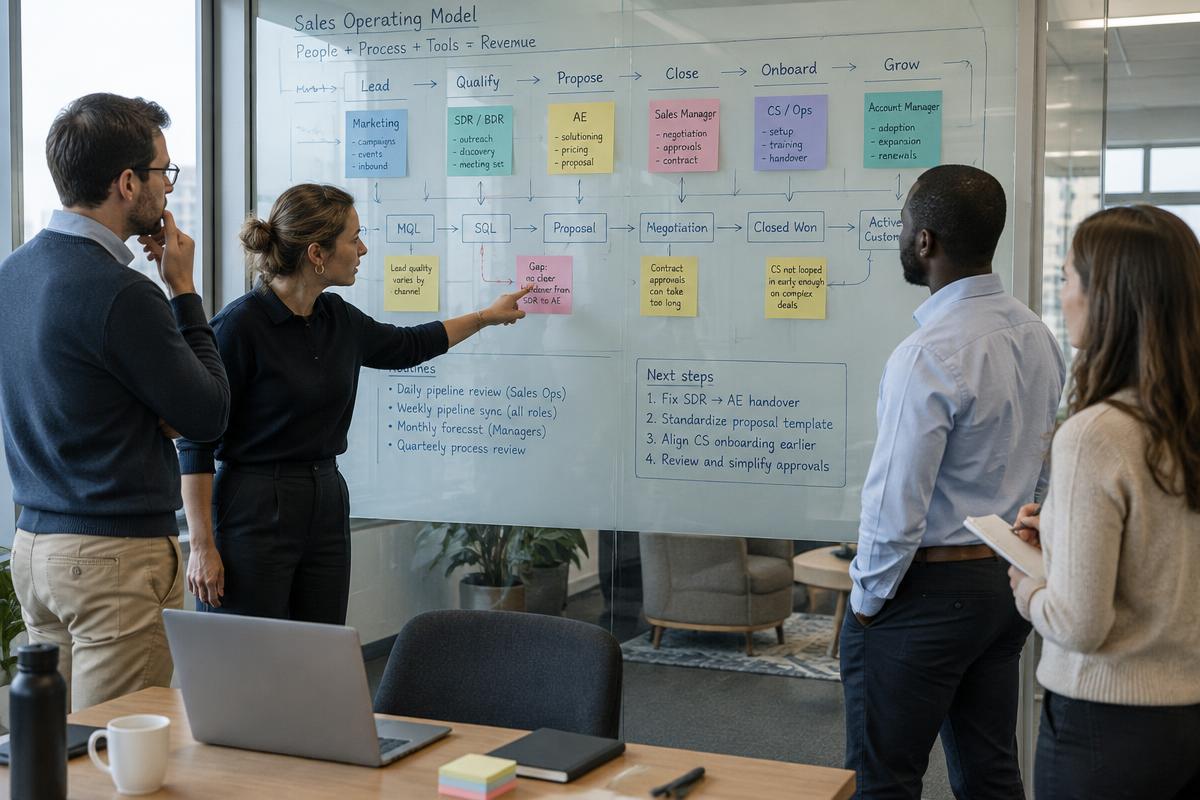
A commercial operating model is the machinery behind the numbers: who does which work, with what rhythm, supported by which systems and connected through which handovers. When results disappoint, organisations often respond with pressure — more activity, more reporting, more follow-up. That treats the symptoms while the structure that produced them remains unchanged.
Structure explains patterns that individuals cannot. If momentum always stalls at the same boundary, if senior time always drains into the same tasks, if every forecast depends on one person's memory, the model — not the people — is the constraint.
If the growth ambition doubled tomorrow, name the first part of the commercial model that would break. That is where to start.
Roles, routines, capacity and handovers set the ceiling.
Roles decide who owns each part of the journey and which decisions they can take without escalation. Routines decide whether the process runs the same way every week or depends on individual discipline. Capacity decides how much senior commercial attention is available for the work that genuinely requires it. Handovers decide whether context survives each change of ownership.
Each of these four can cap growth independently. A clear proposition cannot compensate for roles that overlap; a strong team cannot compensate for routines that exist only in someone's head; extra headcount cannot compensate for handovers that lose the account's history.

Compare the ambition with what the model can carry.
A useful exercise is to state the ambition precisely — new segment, higher deal size, shorter cycle, more predictable pipeline — and then check, stage by stage, what the current model would need to do differently to deliver it. The gaps are rarely everywhere at once. Usually one or two seams carry most of the risk.
Naming those seams changes the conversation from general improvement to specific design: this role needs clearer decision rights, this handover needs defined evidence, this routine needs a fixed rhythm. That is the level at which commercial models can actually be changed.
“The gap between ambition and execution is always located somewhere specific. The work is to find that somewhere.”De Grijff · Commercial operating principle
Trace three recent opportunities through the model.
Take one won deal, one lost deal and one stalled opportunity. Walk each through the commercial journey and mark every handover, every wait and every moment someone had to reconstruct context or escalate a decision the role could not make.
The pattern across the three stories shows where the model loses momentum. Fix the weakest seam first, observe the next set of opportunities, and repeat. Models improve through iteration on live work — not through a redesign announced in a presentation.
References & further reading
- Who owns each part of the commercial journey? — De Grijff
- Where does momentum get lost between teams? — De Grijff
- Commercial Operating Model Scan — De Grijff